
Bellows · Made to order
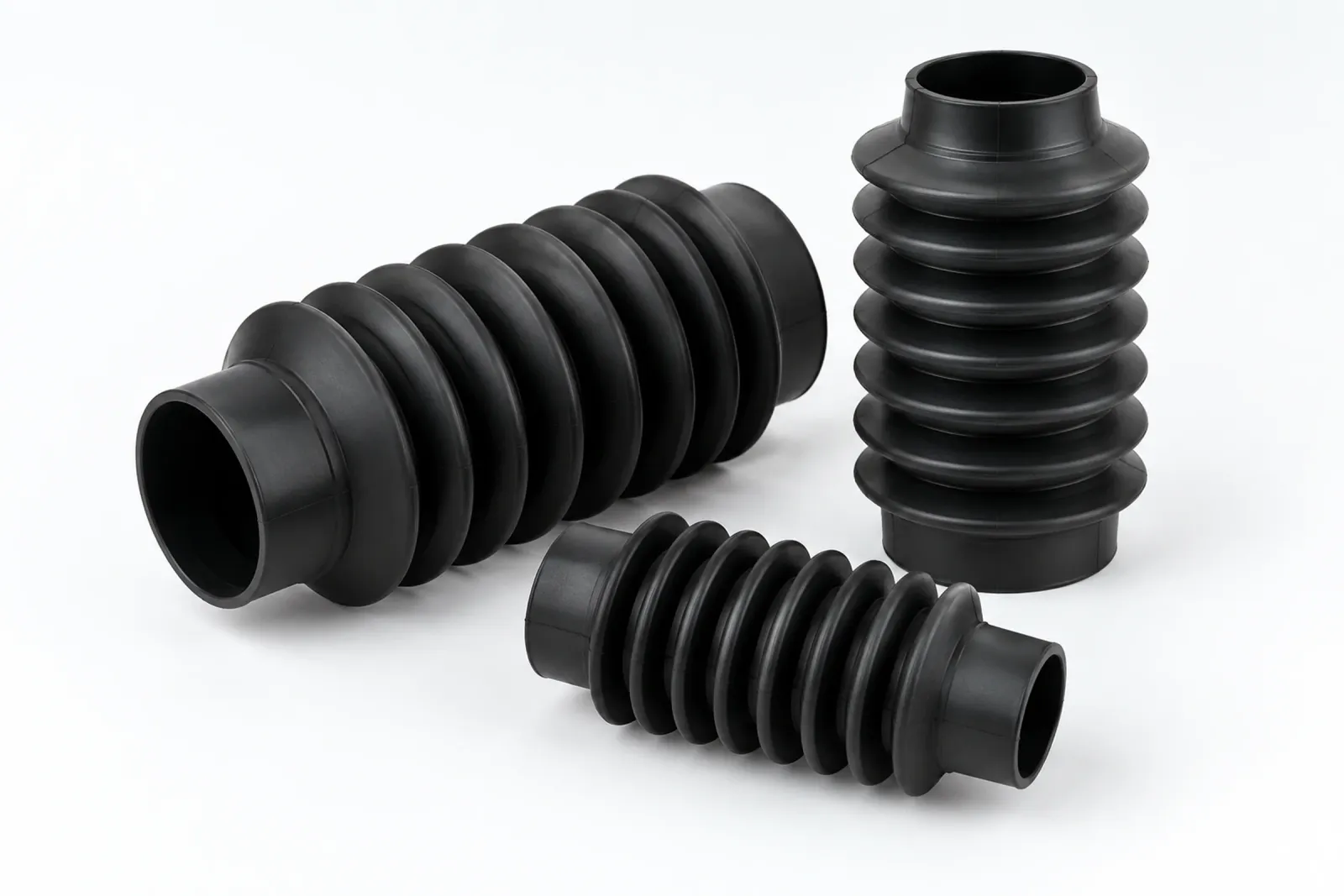
Convoluted Moulded Bellows — For Machine Slides, Actuators and Rods
Convoluted rubber bellows that keep dust, chips, coolant and wash water off moving rods, slides and actuators. Moulded to your ID at each end, your free and compressed length and your stroke, in the compound the environment calls for. Made at our plant in Vilholi, Nashik.
- SEND
- ID at each end, free and compressed length, stroke, convolution count
- HARDNESS
- To your drawing
- TEMPERATURE
- By compound; silicone to +200 °C
- FORM
- Moulded, one piece
- MADE TO ORDER
- ISO 9001:2015
- 09111526A
Key facts
A convoluted bellows is a moulded rubber sleeve with folds that extend and compress with a moving rod, slide or actuator, keeping dust, chips, coolant and wash water off it. Margo Rubber moulds convoluted bellows in one piece to the customer’s drawing in Vilholi, Nashik.
To quote a convoluted bellows, Margo Rubber needs the inside diameter at each end, the free and compressed length, the stroke and the convolution count, plus the medium and temperature. A worn bellows works as a sample, and more convolutions at the same pitch give more travel.
Product gallery
Visual Reference
What we need from your drawing
- End IDs
- Each end to your drawing
- Free length
- To your drawing
- Compressed length
- To your drawing
- Stroke
- To your drawing
- Convolutions
- Count and pitch to your drawing
- Ends
- Plain cuff, flange or clamp groove
Stroke is the number most drawings leave off, and it is the one that decides the convolution count. Send it with the end sizes.
Technical specifications
Engineering Data
- Product family
- Bellows
- Material
- Neoprene, EPDM, NBR, silicone, FKM and the other compounds we mould
- Hardness (Shore A)
- To your drawing
- Tensile strength / elongation
- Per compound datasheet, tested to ASTM D412
- Operating temperature
- By compound; see the table below
- Colour
- Black standard; other colours on request
- Variants
- Thin-wall bellows for mechanical seals; fabric-formed bellows
- Lead time
- Confirmed with the quotation, from approved drawing and approved sample.
- Certifications
- ISO 9001:2015, certificate 09111526A, Integral Certification Ltd.
- Minimum order
- Set by part size and tooling, quoted with the part. Prototype and first-article lots sit outside it.
Dimensional reference
- End IDs
- Each end to your drawing
- Free length
- To your drawing
- Compressed length
- To your drawing
- Stroke
- To your drawing
- Convolutions
- Count and pitch to your drawing
- Ends
- Plain cuff, flange or clamp groove
Available materials
Rubber Compound Options
Select the compound best suited to your operating environment and application requirements.
| Rank | Compound | Temperature | Choose it when |
|---|---|---|---|
| Default | Neoprene (CR) | −40 to +120 °C | Weather, light oil splash and flexing. The usual pick for a machine bellows. |
| Leave Neoprene (CR) if… | the bellows sits in oil or coolant | — | Specify NBR (−30/+120 °C). |
| Leave Neoprene (CR) if… | it lives outdoors or sees hot water | — | Specify EPDM (−40/+140 °C). |
| Leave Neoprene (CR) if… | it runs near an oven or hot platen | — | Specify silicone (−60/+200 °C). |
| Also available | AEM (−40 to +160 °C) · SBR (−30 to +100 °C) · Natural rubber (−20 to +90 °C) | See each compound | The rows above are about which one your part needs. |
Not sure? Send the medium, temperature and load
SERVICE RANGE
−40 to +120 °C
Neoprene (CR)
Key advantages
Why Specifiers Choose Margo
Sized from the stroke
We set the convolution count and wall from your stroke and compressed length, not from the nearest shape we already have.
One-piece moulded
No glued seam to open up in service.
Ends that fit your hardware
Plain cuffs, flanges or clamp grooves, to your mating parts.
Not just automotive boots
This page covers machine and actuator bellows. Vehicle CV and steering boots are made too; ask for them by name.
Industries served
Global Applications
Automotive
Actuator and linkage bellows away from the driveline
Electrical & Electronics
Switchgear and actuator rod covers
Food, Beverage & Pharma
Bellows on filling, capping and packing machines
Transport — Rail & Marine
Coupler, linkage and actuator covers
Manufacturing process
From Compound to Certification
Material compounding
Polymer, fillers and cure system mixed in-house for the medium and temperature on your drawing. Cure is checked on our ODR rheometer.
Tool design
Moulds designed and made for your part and held as a controlled record. When a mould already exists, first samples take 48–72 hours.
Moulding
Compression moulded, with the cavity count set by your volume.
Trimming
Flash trimmed to the edge condition on the drawing.
Inspection
Dimensions against the drawing, hardness and batch sampling. Results go into the shipment documents.
Export packing
Packed by part number with labels that match the inspection sheet. ISPM-15 treated pallets where timber is used.
Quality assurance
Tested in Our Own Lab, Documented in Every Shipment
Every consignment ships with a material test report, a dimensional inspection sheet and a certificate of conformance. Hardness, tensile and elongation (ASTM D412), density, compression set (ASTM D395 Method B), heat ageing, ozone resistance, fluid swell and low-temperature tests run in our own lab, and cure curves run on our own ODR rheometer. PPAP is available on request. RoHS declarations are issued for all compounds.
ISO 9001:2015 · Certificate 09111526A
Integral Certification Ltd
Scope: rubber moulded components — quality management, not a product approval
ISO 9001:2015, certificate 09111526A, Integral Certification Ltd. Scope: rubber moulded components. It certifies the quality management system, not a product approval.
Certification detailProduction metrics
- 60+
- Active clients
- 48–72 hours
- First samples when the mould exists
- 48 hours
- Quotation from receipt of drawing
Downloads
Technical Documentation
Compound datasheets and part drawings are issued on request, under NDA where required.
Request the datasheetFAQ
Technical & Commercial Questions
Answers to the most common questions from engineering teams and procurement managers worldwide.
What is the minimum order for bellows?
There is no fixed number. The minimum is set by part size and tooling, and we quote it with the part. Send the drawing and your annual volume and you get both figures in one reply. Prototype and first-article lots sit outside the minimum.
What do I need to send for a quote?
The ID at each end, free and compressed length, stroke and convolution count, plus the medium and temperature. A worn bellows works as a sample.
Can you make a bellows longer than the old one?
Yes, if the stroke needs it. More convolutions at the same pitch give more travel. Send the new stroke and the space it has to fit.
Do you send test reports with each shipment?
Yes, with every consignment: material test report, dimensional inspection sheet and certificate of conformance. Hardness, tensile to ASTM D412 and compression set to ASTM D395 Method B are tested in-house.
What are your payment and delivery terms for export orders?
TT and LC, agreed per order. Ex-works Nashik or FOB Nhava Sheva. The commercial invoice, packing list and certificate of origin (Nashik Chamber of Commerce) travel with every consignment.
Same compound
Other parts we mould in the same compounds
- Rear Windscreen Glazing Rubber — SUV Platform · Neoprene
- Rubber Oil Filler Cap — Push-In, Sealed or Vented · Neoprene
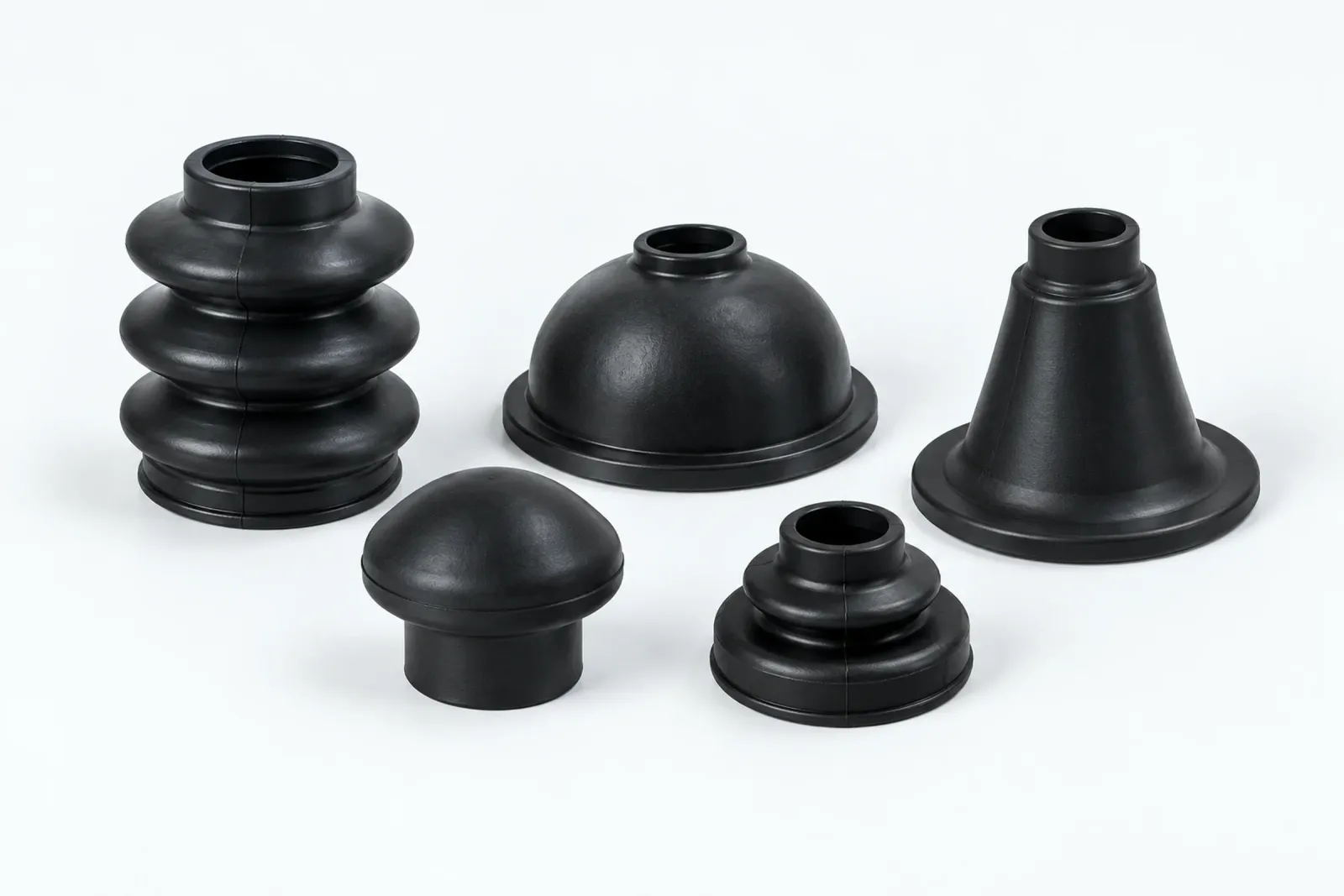
- Dust Covers & Protective Boots — Moulded to Your Rod, Lever or Switch · Neoprene
- Cylinder Head Cover Insulator — Engine Noise Damping · Neoprene
- Air Extractor Flap — One-Way Cabin Pressure Relief · Neoprene
- Rubber Support Pads — Load-Bearing and Vibration-Isolating · Neoprene
Need this part quoted?
Send the drawing or a sample bellows, with the stroke, the medium and your annual quantity. We confirm compound and convolution design, then quote. We respond within 48 hours.