
Gaskets · Made to order
Flat Rubber Washers — Cut or Moulded to Your ID, OD and Thickness
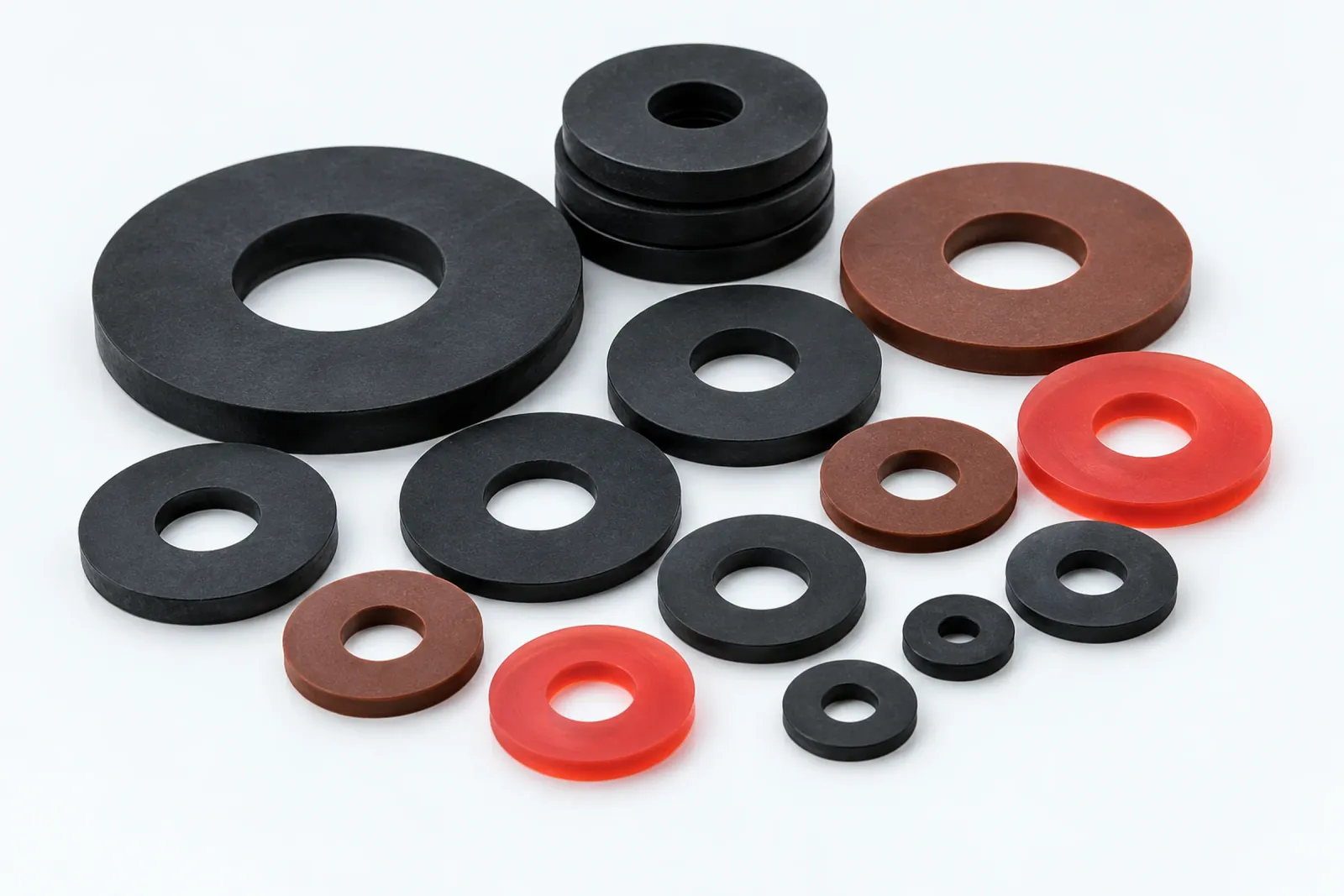
Flat rubber washers made to your inside diameter, outside diameter, thickness and hardness, in any of our eight compounds. We die-cut them from calendered sheet, slice them from extruded tube on a lathe, or compression mould them when the shape isn’t a plain ring. Made at our plant in Vilholi, Nashik.
- SEND
- ID × OD × thickness, hardness
- HARDNESS
- 40–90 Shore A, to your drawing
- TEMPERATURE
- By compound, −60 to +250 °C across the eight
- FORMS
- Die-cut · lathe-cut · moulded
- MADE TO ORDER
- ISO 9001:2015
- 09111526A
Key facts
A flat rubber washer is a ring of rubber sized by three numbers, inside diameter, outside diameter and thickness, plus a hardness. Margo Rubber die-cuts washers from calendered sheet, lathe-cuts them from extruded tube or compression moulds them at its plant in Vilholi, Nashik.
The medium decides a washer’s compound. EPDM suits water, steam and glycol but swells in oil, so Margo Rubber specifies NBR (−30 to +120 °C) for oil and fuel, FKM (−20 to +250 °C) for hot oil and silicone (−60 to +200 °C) for hot, dry joints.
Product gallery
Visual Reference
What we need from your drawing
- Inside diameter
- To your drawing
- Outside diameter
- To your drawing
- Thickness
- To your drawing
- Shape
- Plain ring, or with tabs, flats or bolt holes
- Form
- Die-cut, lathe-cut from tube, or moulded
Send the three numbers and the hardness, or a sample washer, and we return a dimensioned drawing for approval.
Technical specifications
Engineering Data
- Product family
- Gaskets
- Material
- EPDM, NBR, FKM, silicone, neoprene, SBR, AEM, natural rubber
- Hardness (Shore A)
- 40–90 Shore A, to your drawing
- Tensile strength / elongation
- Per compound datasheet, tested to ASTM D412
- Compression set
- Tested to ASTM D395 Method B
- Operating temperature
- By compound; see the table below
- Colour
- Black standard; other colours on request
- Lead time
- Confirmed with the quotation, from approved drawing and approved sample.
- Certifications
- ISO 9001:2015 (certificate 09111526A) covers our moulded components; die-cut and lathe-cut washers are outside the certificate scope.
- Minimum order
- Set by part size and tooling, quoted with the part. Prototype and first-article lots sit outside it.
Dimensional reference
- Inside diameter
- To your drawing
- Outside diameter
- To your drawing
- Thickness
- To your drawing
- Shape
- Plain ring, or with tabs, flats or bolt holes
- Form
- Die-cut, lathe-cut from tube, or moulded
Available materials
Rubber Compound Options
Select the compound best suited to your operating environment and application requirements.
| Rank | Compound | Temperature | Choose it when |
|---|---|---|---|
| Default | EPDM | −40 to +140 °C | Water, steam, glycol and outdoor joints. The default for a washer that gets wet. |
| Leave EPDM if… | the washer sits in oil or fuel | — | Specify NBR (−30/+120 °C), or FKM (−20/+250 °C) for hot oil and fuel. |
| Leave EPDM if… | the joint runs hot and dry | — | Specify silicone (−60/+200 °C). |
| Leave EPDM if… | the washer only cushions or spaces a metal part | — | Natural rubber (−20/+90 °C) or SBR (−30/+100 °C) costs less and does the job. |
Not sure? Send the medium, temperature and load
SERVICE RANGE
−40 to +140 °C
EPDM
Key advantages
Why Specifiers Choose Margo
Three ways to make it
Die-cut from sheet needs a press tool, lathe-cut from tube needs a tube size, and moulding needs a mould. Your quantity and shape decide which one is cheapest. We tell you which, and why.
The cheapest part in the joint
A washer is the part buyers value-engineer into the wrong compound. EPDM in an oil line swells within weeks. We ask for the medium before we quote.
Sized from three numbers
For a plain washer, ID × OD × thickness and a hardness are enough to quote. No 3D model needed.
Same compounds as our gaskets
Every washer comes from the same in-house compounds as our moulded gaskets, with the same test report.
Industries served
Global Applications
Agriculture
Pump, sprayer and tractor-implement washers
Automotive
Drain plugs, fuel and coolant fittings, body fixings
HVAC
Fan and pipe-fitting washers, damper fixings
Mining
Hose couplings and fixings on screens and chutes
Oil & Gas
Flange and fitting washers, in NBR or FKM for hydrocarbons
Transport — Rail & Marine
Panel, hatch and fitting washers
Manufacturing process
From Compound to Certification
Material compounding
Polymer, fillers and cure system mixed in-house for the medium and temperature on your drawing. Cure is checked on our ODR rheometer.
Tooling
A cutting die, a tube size or a mould, whichever the shape needs.
Cutting or moulding
Die-cut from calendered sheet, lathe-cut from tube, or compression moulded.
Finishing
Edges finished to the drawing.
Inspection
Dimensions against the drawing, hardness and batch sampling. Results go into the shipment documents.
Export packing
Packed by part number with labels that match the inspection sheet. ISPM-15 treated pallets where timber is used.
Quality assurance
Tested in Our Own Lab, Documented in Every Shipment
Every consignment ships with a material test report, a dimensional inspection sheet and a certificate of conformance. Hardness, tensile and elongation (ASTM D412), density, compression set (ASTM D395 Method B), heat ageing, ozone resistance, fluid swell and low-temperature tests run in our own lab, and cure curves run on our own ODR rheometer. PPAP is available on request. RoHS declarations are issued for all compounds.
ISO 9001:2015 · Certificate 09111526A
Integral Certification Ltd
Scope: rubber moulded components — quality management, not a product approval
ISO 9001:2015, certificate 09111526A, Integral Certification Ltd. Scope: rubber moulded components. It certifies the quality management system, not a product approval.
Certification detailProduction metrics
- 60+
- Active clients
- 48–72 hours
- First samples when the mould exists
- 48 hours
- Quotation from receipt of drawing
Downloads
Technical Documentation
Compound datasheets and part drawings are issued on request, under NDA where required.
Request the datasheetFAQ
Technical & Commercial Questions
Answers to the most common questions from engineering teams and procurement managers worldwide.
What is the minimum order for flat washers?
There is no fixed number. The minimum is set by part size and tooling, and we quote it with the part. Send the drawing and your annual volume and you get both figures in one reply. Prototype and first-article lots sit outside the minimum.
Can you copy a washer from a sample?
Yes. A used washer has taken a compression set and measures thinner than it was made, so we work to the original thickness, not the squashed sample.
What do I need to send for a quote?
ID × OD × thickness, the hardness, the medium and the working temperature. A PDF, DWG or DXF drawing helps for anything that isn’t a plain ring.
Do you send test reports with each shipment?
Yes, with every consignment: material test report, dimensional inspection sheet and certificate of conformance. Hardness, tensile to ASTM D412 and compression set to ASTM D395 Method B are tested in-house.
What are your payment and delivery terms for export orders?
TT and LC, agreed per order. Ex-works Nashik or FOB Nhava Sheva. The commercial invoice, packing list and certificate of origin (Nashik Chamber of Commerce) travel with every consignment.

Same compound
Other parts we mould in the same compounds
- C-Pillar Garnish Seal — EPDM Hard Foam · EPDM
- Bumper Stopper — Rubber Bump Stop · EPDM
- Tailgate Switch Boot — Sealed Push-Button Cover · EPDM
- 3 Pin Hole Pad — Three-Way Electrical Pass-Through Grommet · EPDM
- Glove Box Stopper — Damped Interior Closure Bumper · EPDM
- Radiator Shroud Flaps — Sealing Out Cooling Air Bypass · EPDM
Need this part quoted?
Send ID × OD × thickness and the hardness, or a sample washer, with the medium and your annual quantity. We confirm compound and method, then quote. We respond within 48 hours.